Historical sacred site
Jelling Mounds, Runic Stones, and Church
Jelling concentrates Denmark's royal memory, runic inscription, burial landscape, and Christian church into one open-air monument group that is small in area but dense in meaning.
At a glance
- Official sourcekongernesjelling.dk
- Citations6 citations
- Hero imageCC BY-SA 2.0 via official-site
- Latest source check2026-04-29
How to read this place: Begin outside on the open ground, then use the interpretation center to test what you noticed.
Plan your visit
The experience works by moving between outdoor monuments and interpretation until political power and religious change become legible together.
Respect essentials
What stands out
Why this place matters
Historical background
History
Jelling is best read as a deliberately arranged royal memorial landscape instead of as a loose group of Viking-age objects. UNESCO identifies the property through its two mounds, two runic stones, and church, and that combination matters because the visible elements speak to different moments in the same political and religious story. The older parts of the site belong to a pre-Christian royal world of burial mounds, monumental display, and dynastic memory. The runic stones then move the visitor from earthwork and memorial presence into carved royal speech. They are not only inscriptions to be translated; they are public claims placed where the ruling family, the dead, the community, and later Christian memory could be made to meet. Kongernes Jelling's interpretation keeps this ensemble logic in view by presenting the stones and surrounding monument area as the center of a larger story about Danish kingship, identity, and conversion.
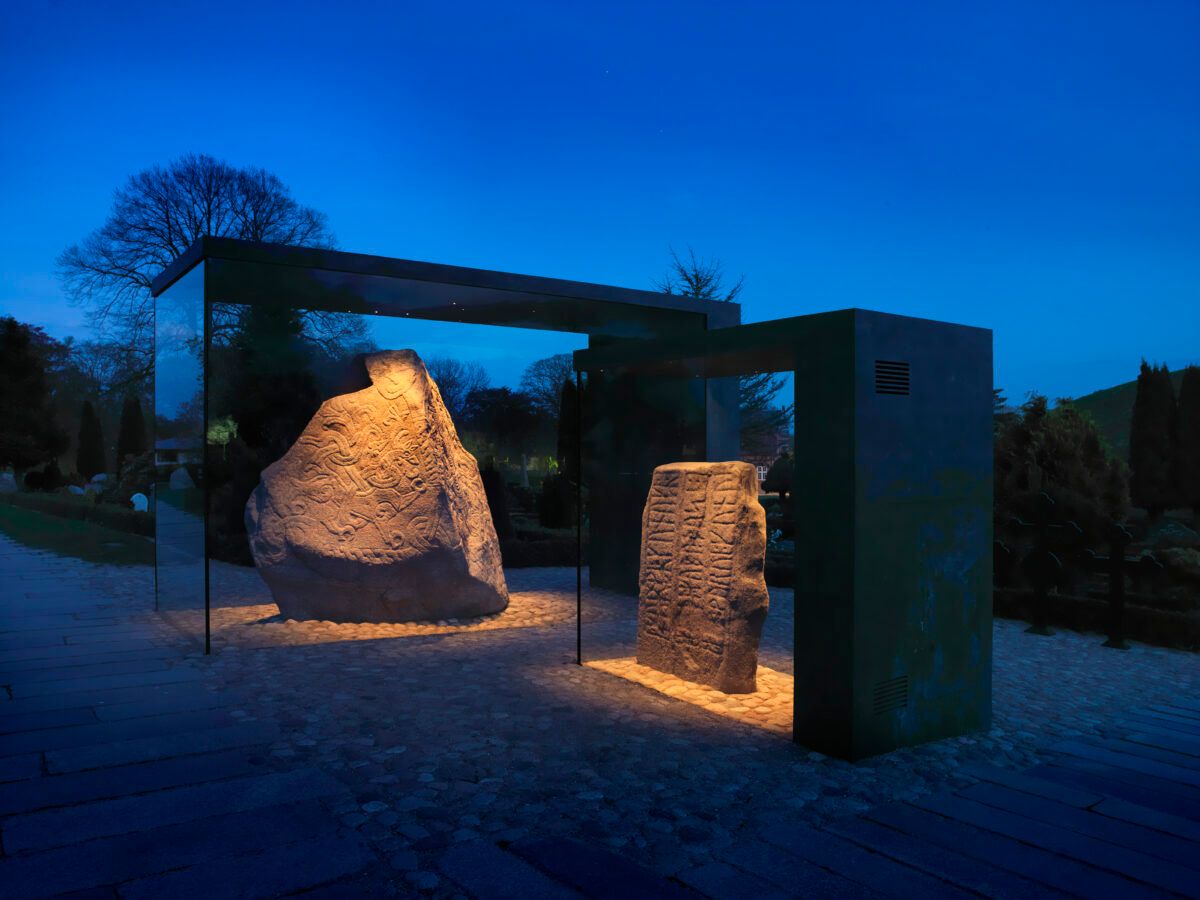
The two rune stones give the site its clearest historical hinge. The smaller stone is associated with King Gorm and Queen Thyra, while the larger stone is tied to Harald Bluetooth and the public claim that he won all Denmark and Norway and made the Danes Christian. That famous claim can sound simple when separated from the place, but the ground at Jelling makes it more complicated and more useful. The inscription stands among monuments of older royal authority, beside a later church, and inside a landscape whose scale was meant to be walked. This is why Jelling carries more than the history of a single ruler. It shows how a ruling house used memory, burial, text, image, and building to make religious change legible. Visitors who circle the mounds before reading the stones see the old language of monumentality first, then the written and Christian claims that reframe it. This is why the larger stone's Christian language should be read beside the whole landscape. Its claim is not floating text; it is a royal message placed where older memorial forms already carried authority. Jelling's historical value comes from seeing how a new religious identity was announced through inherited forms of power.
The church is essential to the historical sequence. UNESCO treats it as part of the property, not as a later add-on that can be ignored after viewing the stones. Its presence marks the Christian layer of the landscape and helps explain why the Jelling monuments became a national symbol: the place joins the memory of Viking-age rulers to a visible Christian building tradition. The present church and its setting also remind visitors that conversion was not only an inscriptional event. Christianity had to be housed, practiced, and made normal in the same communities where older forms of royal memorial display had carried authority. That overlap gives the site its unusual force. The mounds do not disappear; the stones do not become museum labels; the church does not erase the earlier royal ground. The historical meaning comes from their coexistence. That layered evidence also makes the site unusually teachable for visitors who know little about Scandinavian conversion. The monuments show that religious change can be political, architectural, textual, and ritual at the same time, with each layer leaving a different kind of trace.
Modern Jelling history is also a story of protection and interpretation. The stones are now displayed and guarded in a way that changes the visitor's physical relationship to them, but the protection serves the same basic purpose as the World Heritage listing: keeping the ensemble readable for future visitors. Kongernes Jelling gives the compact outdoor route a wider frame, helping people connect the mounds, the stones, the church, and the claims attached to each. The strongest visit therefore resists treating Jelling as a quick photo stop for the large rune stone. It is a small site, but historically dense. The path from mound to stone to church is a path through royal commemoration, public inscription, Christianization, and modern heritage care. The site also rewards attention to scale. The mounds and enclosure traces make royal memory bodily, because visitors must cross ground instead of only read a label. That physical movement is part of the historical evidence: Jelling used landscape, stone, and later church presence to communicate authority in public.
Sacred meaning
Sacred context
Jelling's sacred context is layered because the site preserves religious transition in material form. The mounds belong to a Nordic royal memorial landscape, while the larger rune stone publicly associates Harald Bluetooth with making the Danes Christian. The church then gives that claim a built Christian setting. A visitor should avoid flattening this into a before-and-after story in which one tradition simply replaces another. The power of Jelling is that the older monument language remains visible beside the Christian layer. The sacred context is therefore about overlap: burial memory, royal authority, inscription, conversion, and church presence are held together in one place. The site is therefore sacred through transition as much as through continuity. It asks the visitor to notice how a landscape of royal memory could become a place where Christian identity was declared, housed, and later protected as shared heritage.
The church changes the etiquette of the visit. Even if someone arrives mainly for the rune stones, the ensemble includes a Christian worship building and should be approached with the quiet expected around a church and protected memorial site. That means giving services, local use, barriers, and staff directions priority over photography or route efficiency. The stones also deserve more than curiosity about their age or lettering. They are royal religious statements in a protected landscape, so the respectful approach is to read them slowly, keep the mounds in view, and let the church complete the setting instead of treating it as background architecture.
For sacred-site travelers, Jelling is valuable because it makes conversion visible without pretending to recover every interior belief. UNESCO and Kongernes Jelling can support claims about monument form, royal inscription, and Christianization; they cannot turn the site into a complete record of private devotion. The best interpretation stays with what the landscape actually gives: mounds for royal memory, stones for public claims, a church for Christian continuity, and an interpretation center that helps connect them. That grounded reading makes the site spiritually serious while avoiding romantic filler about Viking mystery. That restraint also protects the Christian side of the site from becoming a slogan. The church is not simply proof of a royal policy; it is the place where the converted landscape continues to be read through worship, memory, and local care. Moving quietly between the stones and church lets both layers remain visible. The practical result is simple: read less quickly. The stones, mounds, and church each carry a different kind of religious evidence, and the site becomes clearer when the visitor lets those forms answer one another.
FAQ
Sources
- Official websitePrimary visitor-facing site for current access and institutional context.
- UNESCO entryAuthority source for the site's pagan Nordic monuments, Christianization significance, and Outstanding Universal Value.
- Wikipedia entryWikipedia article for Jelling Mounds, Runic Stones, and Church.
- Jelling Mounds, Runic Stones and Church (Property 697)Authority source for the site's pagan Nordic monuments, Christianization significance, and Outstanding Universal Value.
- UNESCO World Heritage Site JellingOfficial local source explaining why Jelling is a World Heritage Site and how it marks Christianity becoming the official religion in Denmark.
- About Kongernes JellingOfficial local source for the wider monument area, interpretation centre, and present-day visitor framing.
- Jelling Mounds, Runic Stones and Church (Q4993586)Entity anchor for the Jelling World Heritage monument area in Denmark.
- Jelling Mounds, Runic Stones, and ChurchWikipedia article for Jelling Mounds, Runic Stones, and Church.
- Visit the Jelling StonesOfficial monument page for the Jelling Stones and monument area.
Nearby places
Nearby sacred places in Nordics

Keep exploring