Living sacred site
Sunazuri-no-Fuji, Kasuga-taisha
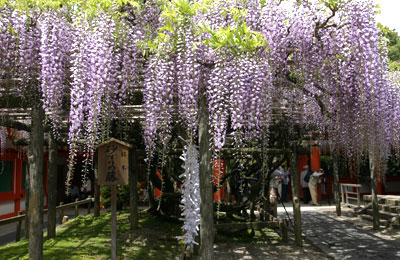
Sunazuri-no-Fuji is an old drooping wisteria at Kasuga-taisha, set beside the gate area of the Main Sanctuary precinct. The shrine connects it with long spring flower clusters, Kasuga Gongen-genki, and the wider wisteria tradition in the shrine grounds.
At a glance
- Official sourcekasugataisha.or.jp
- Citations9 citations
- Hero imageOfficial site image via official-site
- Latest source check2026-04-25
How to read this place: Build the page around the gate-side tree, long clusters, and spring bloom.
Plan your visit
A named wisteria tree that ties seasonal bloom to Kasuga-taisha's older shrine imagery.
Respect essentials
What stands out
Why this place matters
Historical background
History
Sunazuri-no-Fuji is the named drooping wisteria at Kasuga-taisha in Nara, presented by the shrine's official guidance as an old gate-side wisteria associated with long flower clusters and the Kasuga Gongen-genki. Its history belongs to the wider Kasuga-taisha precinct, one of the Shinto components of the Historic Monuments of Ancient Nara World Heritage property. UNESCO frames Ancient Nara through temples, Kasuga-taisha, and the sacred forest, so the wisteria should be understood as a living feature within a protected sacred landscape instead of as a decorative garden object.
The official Sunazuri-no-Fuji page gives the strongest source for the tree's specific identity. It names the wisteria, describes its long drooping flower clusters, and connects it with Kasuga Gongen-genki. That combination is historically useful because it links a plant feature with shrine memory and visual culture. The tree is not just a seasonal bloom stop. It is a named element at a shrine where wisteria, lanterns, cloisters, auxiliary shrines, and the sacred forest help shape the visitor's understanding of Kasuga devotion.
The name Sunazuri-no-Fuji points visitors to a particular kind of attention. In bloom season, people may come first for the flowers, but the official shrine source places the wisteria inside the Main Sanctuary guidance route. Historically, plants at shrines can carry more than botanical interest. They mark memory, season, auspiciousness, and the relationship between sacred buildings and living nature. The available sources document that careful reading here: an old named wisteria, at Kasuga-taisha, tied to shrine tradition and visible in the managed precinct.
For republication, the useful history is narrow and concrete. Sunazuri-no-Fuji is a named old drooping wisteria within Kasuga-taisha, documented by the shrine's official guidance, associated there with long flower clusters and Kasuga Gongen-genki, and situated inside the Ancient Nara World Heritage landscape. Those facts give the page enough depth without inventing legend or turning the tree into a stand-alone monument. Visitors should leave with a clearer sense that this is a active sacred-precinct feature whose meaning comes from the shrine around it.
The wisteria's history also benefits from being described at the right scale. It is too small to carry a full Kasuga-taisha history by itself, but too specific to be folded into generic Nara coverage. The official shrine page gives it a name, location, and shrine-text association. UNESCO and Kasuga sources give the larger sacred landscape. Commons shows the tree and precinct visually. Together those sources document a focused article: Sunazuri-no-Fuji is a living named feature in a major shrine, and its value depends on the relationship between plant, gate-side space, shrine memory, and visitor care.
This focus also keeps the page from becoming seasonal filler. Wisteria bloom is part of the appeal, but Sunazuri-no-Fuji remains meaningful outside perfect bloom because it marks a named sacred-precinct feature. The official guide's connection to Kasuga Gongen-genki gives it a memory layer beyond flowers. The Main Sanctuary guidance places it in the shrine route. The Ancient Nara listing places Kasuga-taisha in a protected sacred landscape. A visitor who knows those links will see more than a photogenic tree.
That right-sized reading is what makes the page useful: the tree is small, but the cited shrine context is rich. in situ today.
Sacred meaning
Sacred context
The sacred context of Sunazuri-no-Fuji comes from its place inside Kasuga-taisha. The tree is approached within a Shinto shrine precinct, near the Main Sanctuary route, and its official description ties it to shrine memory. Visitors should treat it as a sacred-precinct feature, not only as a flower-viewing subject. The best conduct begins with recognizing that the wisteria shares space with worshippers, shrine staff, protected buildings, and the rituals of Kasuga-taisha.
Etiquette should be practical. Do not touch branches, roots, supports, plaques, fences, gates, or nearby shrine fabric. Do not press into the tree for photos, block the route, or stand where worshippers need to pass. Keep voices low, follow posted photography rules, and move on when the area is crowded. The official Kasuga guidance should control current access, while ordinary shrine respect should guide behavior.
The wisteria's sacred context also teaches a slower way of seeing. At Kasuga-taisha, living nature, shrine architecture, lanterns, cloisters, and the sacred forest are not separate experiences. Sunazuri-no-Fuji gathers some of that relationship into one tree. A respectful visitor notices the flower clusters and the gate-side setting, then makes room for others and for worship. The tree should not become a crowd obstacle inside the shrine.
The page should avoid unsupported ritual claims. It can say that Sunazuri-no-Fuji is a named wisteria at Kasuga-taisha and that visitors should protect it and behave respectfully in the shrine precinct because official and heritage sources document those claims. It should not invent prayers, offerings, or special prohibitions beyond posted rules. Tradition-level shrine etiquette is enough: quiet, space, no touching, and attention to the sacred setting.
Bloom season requires extra care. People come for photographs, but the tree's meaning depends on remaining part of the shrine instead of becoming a congested photo stop. Stay outside barriers, keep paths open, and give priority to shrine movement and worship. That protects both the living plant and the sacred atmosphere of Kasuga-taisha.
The sacred context is strongest when visitors connect care for the tree with care for the shrine. Protecting branches and roots is not only conservation behavior. In this setting it also protects the dignity of the worship route. The tree, gate area, and shrine movement share one small space. When visitors step back after taking a photo, avoid touching, and keep the route open, they help the place remain both accessible and sacred.
That care is especially needed when the wisteria is in bloom and visitor attention narrows to the flowers.
FAQ
Sources
- Official websitePrimary visitor-facing site for current access and institutional context.
- UNESCO entryPrimary authority source for Ancient Nara as a sacred urban landscape of Buddhist temples, a Shinto shrine, and a sacred forest.
- Wikipedia entryWikipedia article for Kasuga-taisha.
- Historic Monuments of Ancient Nara (Property 870)Primary authority source for Ancient Nara as a sacred urban landscape of Buddhist temples, a Shinto shrine, and a sacred forest.
- Kasuga-taisha (Q714559)Entity anchor for Kasuga-taisha as a Shinto shrine and component of the Ancient Nara world-heritage property.
- Category:Kasuga-taishaVisual context for the Kasuga-taisha shrine precinct, its halls, gates, cloisters, lanterns, and approaches.
- Category:Main Sanctuary of Kasuga-taishaVisual context for the Main Sanctuary precinct of Kasuga-taisha and its inner auxiliary shrines, trees, and ceremonial spaces.
- Category:Cloisters of Kasuga-taishaVisual context for the Kasuga-taisha cloisters, including their north, south, east, and west precinct structures.
- Main Sanctuary (in the Cloisters)Official Kasuga Taisha guidance page for the inner cloister precinct, including the treasure house, Nejiro steps, Fujinami-no-ya, sacred trees, and auxiliary shrines.
- Category:Sunazuri-no-FujiVisual context for the Sunazuri-no-Fuji wisteria tree at Kasuga-taisha.
- Sunazuri-no-FujiOfficial Kasuga Taisha page describing the old gate-side wisteria, its long flower clusters, and its appearance in Kasuga Gongen-genki.
- Kasuga-taishaWikipedia article for Kasuga-taisha.
Nearby places
Nearby sacred places in Japan

Hashidono Hall, Kamigamo Jinja
A small Kamigamo Jinja forecourt structure that turns a stream crossing into part of the shrine's ordered approach.

Inoue Shrine (Mitarai Shrine), Shimogamo Shrine
A quiet Shimogamo water stop where good-health prayer and summer observance give the pond edge ritual weight.
Mitarai Pond, Shimogamo Shrine
A small Shimogamo water edge where visitors encounter cleansing practice at ground level.

East Corridor, Itsukushima Shrine
Itsukushima's east-side passage turns a walk over the tidal edge into a measured approach through roof, posts, sea, and shrine order.
Regional journeys
Journeys in Japan
Keep exploring